
Minibop’s Full CLIMB Music Program and Progression
Music should not feel random.
One of the first questions directors ask is:
“How does this music program actually work?”
Minibop’s CLIMB Music Curriculum provides a structured, year-long progression designed specifically for Preschool, Pre-K, and Transitional Kindergarten (TK).
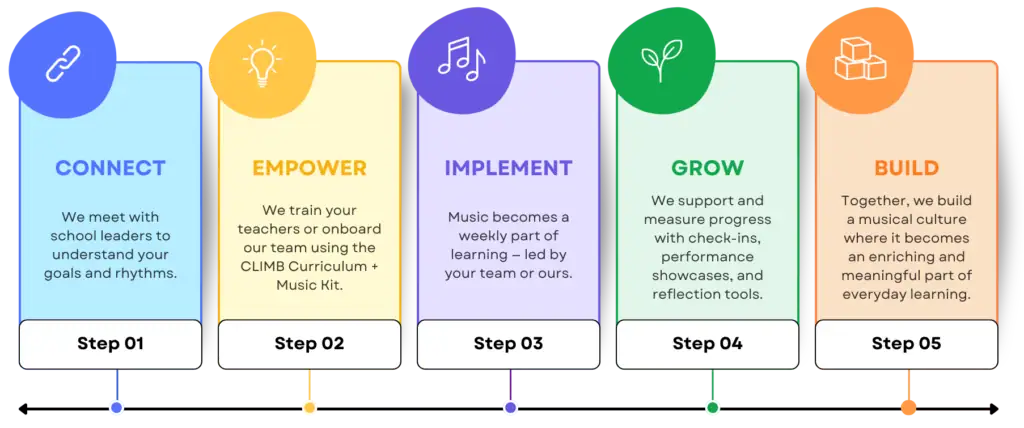
Whether implemented through our Music Enrichment Kits or led by a Minibop full-service teacher, the structure remains the same:
Clear progression.
Repeatable lessons.
Real skill development.
The CLIMB Learning Path
At the center of our curriculum is the CLIMB Learning Path.
Children build mastery across five foundational early childhood music concepts:
- Beat
- Rhythm
- Tempo
- Dynamics
- Pitch
You’ll see a visual of the CLIMB Learning Path below. It shows how children move from exposure to independence across ages.
These five concepts repeat throughout the year — but at increasing levels of depth.
That’s progression.
How the Curriculum Runs Across the School Year
Monthly Units That Support Classroom Themes
Each month includes a unit aligned with classroom learning themes (such as Bodies, Colors, Transportation, or Animals).
Within each unit:
- The same five music foundations are reinforced.
- Skills build from previous months.
- Music connects naturally to literacy, math, and social-emotional learning.
Music becomes part of the school day, not an extra add-on.
Lessons are intentionally short and repeatable so they fit into circle time or transitions.
Weekly Lessons (10–20 Minutes)
A typical lesson includes:
- Welcome song with steady beat
- Rhythm activity (clapping syllables or echo patterns)
- Concept focus (tempo, pitch, or dynamics exploration)
- Movement integration
- Closing repetition
Teachers do not need formal music training. They need structure and consistency.
What Builds From Fall to Spring
Here’s how skill progression looks across the year.
Beat
- Fall: Feel and move to steady beat
- Winter: Maintain beat independently
- Spring: Transfer beat across activities
Rhythm
- Fall: Echo simple patterns
- Winter: Identify long and short sounds
- Spring: Create short rhythmic sequences
Pitch
- Fall: Explore high and low
- Winter: Match simple tones
- Spring: Sustain melodic phrases
Tempo
- Fall: Move fast and slow
- Winter: Start and stop on cue
- Spring: Adjust speed intentionally
Dynamics
- Fall: Explore loud and soft
- Winter: Control voice and instrument volume
- Spring: Apply dynamics in storytelling and song
This is how musical skills compound from September through June.
How It Builds Across Ages (Infant Through TK)
The CLIMB framework is developmentally aligned for:
- Infants / Toddlers
- 2s
- 3s
- 4s
- Pre-K
- Transitional Kindergarten (TK)
For example:
A 3-year-old feels and maintains steady beat.
A Pre-K student keeps beat while clapping syllables.
A TK student transfers rhythm awareness to early reading patterns.
The framework stays consistent. The complexity increases.
This consistency supports both teacher confidence and measurable child growth.
How Schools Implement the CLIMB Curriculum
Schools typically choose one of two models:
1️⃣ Music Enrichment Kits
Our kits provide:
- Structured lesson cards
- Instruments and materials
- Clear progression guidance
- Short, repeatable lessons
This allows classroom teachers to confidently lead music using the CLIMB framework.
2️⃣ Full-Service Minibop Teacher
A trained Minibop educator leads weekly music classes using the same CLIMB progression.
This option provides:
- Live instruction
- Professional modeling
- Seamless classroom integration
Both models follow the same year-long structure.
The difference is who delivers it.
Why a Structured Preschool Music Curriculum Matters
Intentional music education supports:
- Early literacy development
- Pattern recognition for math readiness
- Executive function and impulse control
- Emotional regulation
- Listening and focus
Music activates multiple areas of the brain at once.
When structured correctly, it strengthens classroom learning across the board.
If you are looking for a Preschool, Pre-K, or TK music curriculum that runs clearly across the year — without feeling random — the CLIMB Learning Path was designed for that purpose.
Music should build.
And when it builds intentionally, children do too.